Thursday, September 27, 2018

7 best chilled red wines


For those in the know, red wines don't always have to be served at room temperature, while whites must be cool. Our European counterparts often serve simple reds chilled, but it seems to have taken longer for the UK to catch on.

Lighter skinned grapes such as pinot noir, cabernet franc and Beaujolais are the best place to start. An hour or two in the fridge to take the temperature to 12C to 14C should suffice. You don’t want to over-chill the wine, otherwise you could lose some of the wonderful aroma.

Heavier, full-bodied reds with lots of tannin won’t perform as well chilled, so leave the barolo in the wine rack for now.

A chilled red works wonderfully with barbecued food or as an aperitif. Charcuterie is another dream combination - just close your eyes and imagine you’re in a rustic tapas bar.

Here are the best chilled reds to drink right now.

Doing exactly what it says on the tin (or the label in this case), this sexy Argentinian malbec is best enjoyed chilled to really bring out the lively fruit. Full to the brim with juicy cherries alongside more savoury notes of black pepper and dried herbs, this was named as one of Decanter Magazine’s 30 Great New World Buys and we can certainly see why. It’s just the ticket with a plate of charcuterie or a selection of cold cuts.

This is a young, fresh, fruity wine made from 100 per cent cabernet franc grapes grown in the Loire Valley. The winery and vineyard were fully converted to organic practices in 2015, which shows in this pure style with soft tannins. Borough Wines suggests serving with Lebanese food, which would work a treat. It’s certainly light enough to pair with white meats, too. Not only is this wine organic, it’s also suitable for vegans and, during the summer, we’d encourage you to try lightly chilling before serving.

Beaujolais is often held up as the perfect example of a chilled red, and the Definition from Majestic is the final word on the matter. It uses only the finest gamay grapes, which gives a depth and complexity you wouldn’t expect to find in such a light wine. Smooth and fruity, expect dark cherries and a delicate floral aroma.

Soft and easy to drink but certainly not lacking in character, this fruity little number from Italy really delivers with its rich plummy flavours. We think it represents good value at this price, and after an hour in the fridge lends itself to almost anything – so no need to keep for special occasions.

Turning the traditional on its head is M&S with this German pinot noir that happily holds its own against many of its Burgundian equivalents. Wonderfully aromatic, even after a light chill, with a well-balanced touch of oak, this medium bodied red has a slightly gamey finish that will be absolutely perfect paired with grouse when in season.

This picturesque vineyard is nestled between ski resorts in the Savoie region – an area becoming increasingly popular with sommeliers. Aside from getting a mouthful of juicy red berries, you’ll also find this a refreshingly light red with flinty minerality which really comes to the fore with a quick chill.

Well-structured acidity makes the mouth water and aromatic violet fills the nose in this red from France’s Morgon region. It’s an easy-drinking style without being a pushover, pairing well with everything from barbecued meats and charcuterie, to grilled asparagus and meaty fish.

Monday, August 27, 2018

How to choose the best red wine

What’s the best red wine? You’ve probably asked yourself this question a dozen times before. But how do you make that judgment call? Do you ask your local wine clerk or scan the labels for something that sounds familiar or prestigious?

The problem with wine recommendations is that they’re often very subjective. What works for one person won’t necessarily work for another, which leaves you with a tricky dilemma. Let’s look at a few ways you can discover a red wine that suits your preferences.


What makes red wine ‘great’?

A great red wine depends on personal taste. To choose the perfect wine for your palate, it’s important you try out as many grape varietals as possible. Red wine tastes different from white wine in a number of ways:

Higher levels of tannin
Higher levels of alcohol
Heavier body
Different flavour profile
Potentially increased complexity

All these qualities come from the fermentation process, where the grapes skins are left in the tank along with the juice. Barrel and bottle ageing also play a large part, with a more aerobic style of wine-making changing the way a wine matures. It’s the nature of these processes and the quality of the grape that has the biggest effect on the flavour and character of the wine.

Finding your sweet spot

Just because a wine is vintage or well-aged, doesn’t mean you have to enjoy it. Ageing aromas are an acquired taste, much like truffles or mature cheeses. For those new to wine tasting, it’s good to vary your options and get adventurous with your choices. We recommend you start with the following grape varieties to get a sense of what you prefer.

Pinot Noir – acidity

Pinot Noir is the perfect red wine for understanding acidity. If you like Pinot Noir, the chances are you’ll enjoy other highly acidic red wines such as Grenache. When you taste Pinot Noir for the first time, you’ll experience a puckering sensation in your mouth, as though drinking a fizzy drink. This is the acid at work. A good bottle of Pinot Noir has exactly the right balance of tannins and acidity to compliment the fruity nature of the wine.

Syrah/Shiraz – body

The body of the wine is also important. Red wine tends to be heavier-bodied than white because of their composition, but each varies according to its origins. Syrah or Shiraz (as the New World likes to call it) is an excellent example of a full-bodied red wine.

You should be able to taste darker flavours such as plum, chocolate and tobacco in Syrah, which add to its velvety/milky quality. If this hits the spot, we recommend you try Malbec for a similar wine tasting experience.

Cabernet Sauvignon – tannin

Next up are tannins. Cabernet Sauvignon is a notoriously tannic wine, which leaves your mouth feeling dry when you swallow. It’s perennially popular in the wine-drinking world, because of its rich, spicy flavour and complementary pairing with red meat. If you like Cabernet Sauvignon, you’ll also enjoy Merlot, Chianti and Rioja, which have similar qualities.

Zinfandel – alcohol

Most red wines are high in alcohol, but Zinfandel is one of the highest. A good bottle is around 15% ABV (the upper end of the scale). The high alcohol content causes Zinfandel to feel ‘bold’ and ‘full’ or, in other words, more intense.

High alcohol levels come from a high amount of sugar in the fermentation process, which the yeast converts into ethanol. You can taste this sweetness in Zinfandel through its ripe, fruity flavour. Shiraz and Madeira are other high-alcohol wines.

Don’t compromise on quality

Another defining factor of great red wine is its quality. You can drink all the tannic wine you want, but if it’s cheap, nasty plonk you’re not going to enjoy the experience. That’s not to say you have to spend hundreds of pounds at the auction house. In fact, it’s possible to pick up the perfect bottle of red wine for less than £40. Here’s what you should be looking for:

Complexity – this sounds a little pretentious, but really what you’re after is a wine with a large array of flavours. For example, a great Cabernet Sauvignon will have hints of cherry, blackcurrant, spice, green pepper, and, if it’s a little older, cigar box, leather, chocolate and savoury.

Intensity – how clearly can you identify each flavour? The more obvious they are, the more intense the wine, and the higher the quality.

Balance – the best wines hold all their flavours in balance. If it’s fruity, earthy, and well-structured, you’re on to a winner.

Tuesday, July 24, 2018

Three hot weather wine options beyond just rose

A friend recently asked me for advice on wines to drink during summer as the heat bears down. She had enjoyed several rosés but was looking for a way to spruce up her experience beyond pink. Her favourite chardonnay seemed a bit plodding in the hot weather, and cabernet just seemed so autumnal, she said. And she wanted something to serve guests at an upcoming patio party.

After resisting my initial impulse to tell her to double down on rosé, I offered her three suggestions for jazzing up wine in summer.


Try a wine cocktail

Start your evening - and welcome your guests - with something simple.

My favourite is a port tonic, which can be mixed in about as much time as it takes to pull a cork. Popular throughout Portugal, a port tonic is the aperitif of choice in the Douro Valley, the home of port wine.

It's essentially a riff on gin and tonic, with lower alcohol. Just pour one part white port and two parts tonic water over ice and garnish with your favourite citrus fruit. My favourite garnishes are a slice of lime and a sprig of mint. A highball glass is traditional in Portugal, but you can use a tumbler instead. The tonic and citrus provide a refreshing foil for the white port and help invigorate your palate for the meal to come.

Port tonic seems to be enjoying a mini-trend here in the United States. It certainly will be newer and more fashionable than a kir (crème de cassis topped with white wine) or kir royale (using sparkling wine), two French aperitifs that had their vogue a few decades ago.

There is a problem, however: White port can be hard to find. Fonseca and Sandeman are good producers. (Sandeman has several cocktail recipes on its website, including one made with fino sherry and tonic. And yes, Sandeman makes a very nice fino.)

Explore lighter styles of wine

Vinho verde, another Portuguese classic, is ideal for hot weather. It's lower in alcohol than most wines and is often spritzy with carbonation for extra refreshment. And it's usually cheap - often less than US$10 (S$13.65) a bottle - making it a potential competitor for rosé, which has crept up in price as it has soared in popularity.

German Riesling, especially from the Mosel region, and fresh, young Austrian gruner veltliner are excellent choices when the mercury soars. And they are exceptionally friendly with a wide variety of foods, including meats.

Don't give up on the wines you love to drink, though. If chardonnay is your white of choice, look for racier, unoaked versions, such as Macon-Villages from France. And there are any number of New World chardonnays fermented and aged in stainless steel or concrete. Ask your retailer to recommend a few.

Chill your reds


We need to get away from the idea that red wine should be served at room temperature. That's especially true in the summer. Serving it cooler brings out its fruit and often helps the wine taste more balanced.

We routinely chill some lighter-style reds - lambrusco, Beaujolais and barbera, for example. These versatile wines are great for summer fare. But cabernet, merlot, zinfandel and other heftier wines also benefit from some time in the refrigerator door, an ice bucket or one of those chiller sleeves you keep in your freezer. (If you're a wine fiend like me, you have more than one.)

If you forget about it and the wine gets too cold, don't worry. It will warm up. Taste it while it does, and you will see how the wine changes with the temperature.

After all, you have nothing to lose except your summer wine doldrums.

Wednesday, June 27, 2018

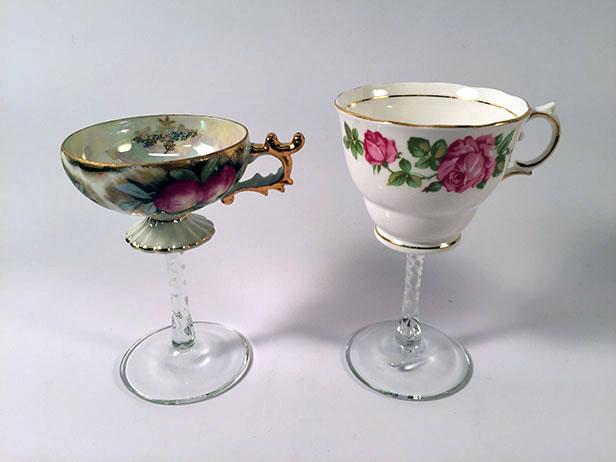
How to Turn Tea Cups into Cocktail Glasses

Anyone who follows my Instagram page (@nbritsky), knows I am a big cocktail geek. I found these amazing stemmed tea cups on Etsy and fell in love. When trying to order them I discovered they didn't ship to the U.S. I'm not one of those guys that finds something on Etsy and yells "I can make that!" You really should support the artists and reward them for their cool idea. But I made an exception because of the shipping rules. Here is my process. I've done it 10 times so far.

1. Gather all your supplies.
You will need some sandpaper (100-200 grit), two-part epoxy, a stemmed wine glass, a tea cup (optional saucer), glass cutter, knife/scissors and a flexible plastic cup.


2. Score the stem.
Start by scoring the top of the wine stem with the glass cutter. It doesn't have to be perfect since it is very challenging to keep it straight. We have a way to correct the errors later in the process.


3. Snap off the stem.
It's not a bad idea to wear gloves and safety glasses for this next step. Firmly grab stem of the wine glass in one hand and the bowl of the glass in the other. Stand over a trash can and snap the two parts. It should break without a lot of force. If you are struggling too much, use the glass cutter to score the stem again.


4. Sand the cut smooth.
Sand the top of the wine stem until it is parallel with the bottom.


5. Prep the tea cup.
Use sandpaper to rough up the bottom of the tea cup. This will help the epoxy adhere to its surface.


6. Get ready for the glue.
Cut a hole in the top of a plastic cup and place it over the stem. Then see if your tea cup just rests on top of the stem. If the stem is too low, shim the plastic cup. I found business cards work well. If the stem is too high, shim the stem. Business cards are too big so you could cut them or use some big washers.


7. Glue cup to stem.
Mix a bit of two-part epoxy and apply a dab on the stem (which the plastic cup is over). Then place your tea cup on top. Let this sit for 24 hours or whatever the instructions on the glue package suggest. When it is done, use the knife or scissors to cut the plastic cup off. Voila! You have yourself a fancy cocktail tea cup.

Monday, May 21, 2018

How to Drink Like An Italian


One of the finer points of Italian style isn’t found in fashion boutiques or art museums, but over cocktail hour. After all, in a country where wine flows like water, drinking is a true art. And, like any art form, it has its own set of rules and etiquette.

Heading to Italy? Here’s how to sip in style… Italian style!

Drinking wine in Italy

Italians take their wine seriously. That said, they’re here to enjoy it—and far from snobby, are usually rather laid-back about choosing a vintage. Wine is meant to go with food, after all, so it is often simple… and relatively cheap!

For this reason a nice house wine isn’t necessarily a terrible wine (and it’s usually better than what you’d find as a house wine in most other countries). Plus, it tends to be a local variety. Start with the basic rules, like to pair red wine with meat and white wine with fish, and ordering local wines, and you’ll be off to a good start. Try a classic Chianti in Tuscany, a Valpolicella in Veneto, a Nero d’Avola in Sicily and a Pinot Grigio or other white wine in Friuli-Venezia Giulia. For more, don’t miss our non-stuffy traveler’s guide to Italian wines.

Drinking beer in Italy

While less historically popular than wine, beer is another appropriate alcohol for lunch or dinner. And it’s a must for a cookout or for a pizza night with friends! The famous Italian brands Morena, Moretti and Peroni have been around for a while. Much more excitingly, however, is that microbrews are becoming trendy, with small, local craft brewers popping up around the country. (There are now more than 500 breweries nationwide). Italian craft brewers typically use high-quality, local ingredients, applying much of the experience gained from wine-making to their beer brewing. Head to a birrificio and you can be sure that you’re getting a decent local brew! We like especially like Birra + at Via Alessandra Macinghi Strozzi 14 in Rome or Birrificio Lambrate at Via Adelchi 5 in Milan.

Drinking cocktails in Italy (and what “aperitivo” really is)

The aperitivo is Italy’s answer to the happy hour: Starting around 7pm and ending around 9pm, pay a flat rate for a drink and you are welcome to eat all you want from the various appetizers offered at the bar. (Here’s more about aperitivo in Italy).

While wine is common, this is also an especially popular time to have a cocktail. Most Italian cocktail bars will have your classic, internationally-known mixes alongside signature, regional ones. Here are some of our favorites (and don’t miss our  post on the best Italian cocktails for summer):

Campari – Invented in Italy in the 1800’s and still produced today in Milan, Campari is a bitter made with liquor and infused herbs and fruit. It’s used as the base of many Italian cocktails, such as the Negroni and Americano.

Aperol – A liquor nearly identical to Campari, Aperol is much less bitter and has a lower alcohol content.

Negroni – Perhaps the easiest to make for its 1:1:1 ratio, this drink is made of one part gin, one part red vermouth and one part bitters, traditionally Campari.

Sbagliato – A negroni sbagliato, or negroni incorrect, has a fantastic story to go with this fantastic drink. They say that a bartender in Milan at the famous Bar Basso accidentally grabbed prosecco instead of gin, mixing equal parts prosecco, red vermouth and bitters. Before he could throw out the drink, the guest approved of it’s taste and the negroni sbagliato (sbah-lyee-ah-to) was added to the cocktail list! Perfect for an aperitivo or even a brunch, the negroni sbagliato is still as popular as ever.

Americano – The bright red Americano is made with part Campari and part red vermouth, with just a splash of soda water. Its name is supposedly a nod to the American customers who seemed to like the drink so much, but is enjoyed by many an Italian during happy hour, too!

Spritz  – An especially popular aperitif in northern Italy, Spritz is made with a sparkling wine like Prosecco, a dash of a bitter liquor such as Campari or more commonly Aperol and finished with sparkling mineral water. This is a must-drink when in Venice, where it is abundant and cheap, and perfect for cooling down by the water on a hot day!

Martini – A vermouth cocktail (made, of course, with alcohol from the Martini & Rossi brand headquartered in Turin, Italy, surely not with an imported brand!) and mixed with a sparkling wine. Martini is a cool classic, great for the hip bars of Milan.

And one last Italian drink: the digestivo

Having a “digestive” refers to the Italian tradition of drinking an after-dinner drink to help digestion. Unlike the aperitivo, which is often dry or bitter to stimulate an appetite, a digestivo can be bitter or sweet.

Amaro – Italian for “bitter,” an amaro is made with dozens of different herbs and roots that vary based on type and brand.

Grappa – A shot of grappa will definitely get things moving after a heavy dinner or to start a long night. A (very) high-proof wine liquor made from grapes, this drink is all Italian: It has to be made in an Italian territory to be considered true grappa. Try adding it to your espresso in the morning for a caffe corretto to start your day off right!

Italians don’t consider alcohol as something that should be vilified, but as a natural and acceptable part of life, one that they want to celebrate and do right.

So take a cue from the Italians and learn how to sip in effortless style (without, of course, overdoing it!)