Wednesday, June 27, 2018

How to Turn Tea Cups into Cocktail Glasses

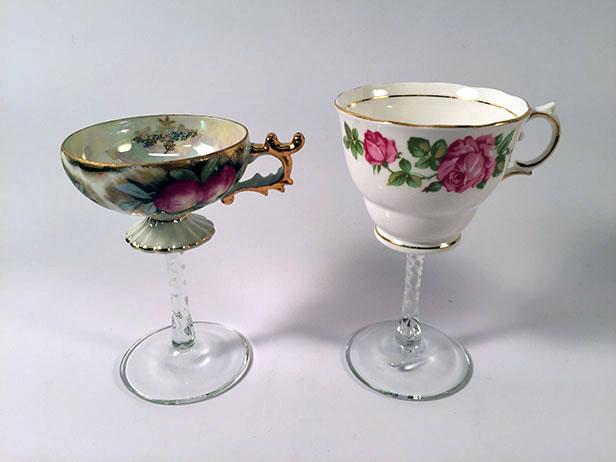
Anyone who follows my Instagram page (@nbritsky), knows I am a big cocktail geek. I found these amazing stemmed tea cups on Etsy and fell in love. When trying to order them I discovered they didn't ship to the U.S. I'm not one of those guys that finds something on Etsy and yells "I can make that!" You really should support the artists and reward them for their cool idea. But I made an exception because of the shipping rules. Here is my process. I've done it 10 times so far.

1. Gather all your supplies.
You will need some sandpaper (100-200 grit), two-part epoxy, a stemmed wine glass, a tea cup (optional saucer), glass cutter, knife/scissors and a flexible plastic cup.


2. Score the stem.
Start by scoring the top of the wine stem with the glass cutter. It doesn't have to be perfect since it is very challenging to keep it straight. We have a way to correct the errors later in the process.


3. Snap off the stem.
It's not a bad idea to wear gloves and safety glasses for this next step. Firmly grab stem of the wine glass in one hand and the bowl of the glass in the other. Stand over a trash can and snap the two parts. It should break without a lot of force. If you are struggling too much, use the glass cutter to score the stem again.


4. Sand the cut smooth.
Sand the top of the wine stem until it is parallel with the bottom.


5. Prep the tea cup.
Use sandpaper to rough up the bottom of the tea cup. This will help the epoxy adhere to its surface.


6. Get ready for the glue.
Cut a hole in the top of a plastic cup and place it over the stem. Then see if your tea cup just rests on top of the stem. If the stem is too low, shim the plastic cup. I found business cards work well. If the stem is too high, shim the stem. Business cards are too big so you could cut them or use some big washers.


7. Glue cup to stem.
Mix a bit of two-part epoxy and apply a dab on the stem (which the plastic cup is over). Then place your tea cup on top. Let this sit for 24 hours or whatever the instructions on the glue package suggest. When it is done, use the knife or scissors to cut the plastic cup off. Voila! You have yourself a fancy cocktail tea cup.

Monday, May 21, 2018

How to Drink Like An Italian


One of the finer points of Italian style isn’t found in fashion boutiques or art museums, but over cocktail hour. After all, in a country where wine flows like water, drinking is a true art. And, like any art form, it has its own set of rules and etiquette.

Heading to Italy? Here’s how to sip in style… Italian style!

Drinking wine in Italy

Italians take their wine seriously. That said, they’re here to enjoy it—and far from snobby, are usually rather laid-back about choosing a vintage. Wine is meant to go with food, after all, so it is often simple… and relatively cheap!

For this reason a nice house wine isn’t necessarily a terrible wine (and it’s usually better than what you’d find as a house wine in most other countries). Plus, it tends to be a local variety. Start with the basic rules, like to pair red wine with meat and white wine with fish, and ordering local wines, and you’ll be off to a good start. Try a classic Chianti in Tuscany, a Valpolicella in Veneto, a Nero d’Avola in Sicily and a Pinot Grigio or other white wine in Friuli-Venezia Giulia. For more, don’t miss our non-stuffy traveler’s guide to Italian wines.

Drinking beer in Italy

While less historically popular than wine, beer is another appropriate alcohol for lunch or dinner. And it’s a must for a cookout or for a pizza night with friends! The famous Italian brands Morena, Moretti and Peroni have been around for a while. Much more excitingly, however, is that microbrews are becoming trendy, with small, local craft brewers popping up around the country. (There are now more than 500 breweries nationwide). Italian craft brewers typically use high-quality, local ingredients, applying much of the experience gained from wine-making to their beer brewing. Head to a birrificio and you can be sure that you’re getting a decent local brew! We like especially like Birra + at Via Alessandra Macinghi Strozzi 14 in Rome or Birrificio Lambrate at Via Adelchi 5 in Milan.

Drinking cocktails in Italy (and what “aperitivo” really is)

The aperitivo is Italy’s answer to the happy hour: Starting around 7pm and ending around 9pm, pay a flat rate for a drink and you are welcome to eat all you want from the various appetizers offered at the bar. (Here’s more about aperitivo in Italy).

While wine is common, this is also an especially popular time to have a cocktail. Most Italian cocktail bars will have your classic, internationally-known mixes alongside signature, regional ones. Here are some of our favorites (and don’t miss our  post on the best Italian cocktails for summer):

Campari – Invented in Italy in the 1800’s and still produced today in Milan, Campari is a bitter made with liquor and infused herbs and fruit. It’s used as the base of many Italian cocktails, such as the Negroni and Americano.

Aperol – A liquor nearly identical to Campari, Aperol is much less bitter and has a lower alcohol content.

Negroni – Perhaps the easiest to make for its 1:1:1 ratio, this drink is made of one part gin, one part red vermouth and one part bitters, traditionally Campari.

Sbagliato – A negroni sbagliato, or negroni incorrect, has a fantastic story to go with this fantastic drink. They say that a bartender in Milan at the famous Bar Basso accidentally grabbed prosecco instead of gin, mixing equal parts prosecco, red vermouth and bitters. Before he could throw out the drink, the guest approved of it’s taste and the negroni sbagliato (sbah-lyee-ah-to) was added to the cocktail list! Perfect for an aperitivo or even a brunch, the negroni sbagliato is still as popular as ever.

Americano – The bright red Americano is made with part Campari and part red vermouth, with just a splash of soda water. Its name is supposedly a nod to the American customers who seemed to like the drink so much, but is enjoyed by many an Italian during happy hour, too!

Spritz  – An especially popular aperitif in northern Italy, Spritz is made with a sparkling wine like Prosecco, a dash of a bitter liquor such as Campari or more commonly Aperol and finished with sparkling mineral water. This is a must-drink when in Venice, where it is abundant and cheap, and perfect for cooling down by the water on a hot day!

Martini – A vermouth cocktail (made, of course, with alcohol from the Martini & Rossi brand headquartered in Turin, Italy, surely not with an imported brand!) and mixed with a sparkling wine. Martini is a cool classic, great for the hip bars of Milan.

And one last Italian drink: the digestivo

Having a “digestive” refers to the Italian tradition of drinking an after-dinner drink to help digestion. Unlike the aperitivo, which is often dry or bitter to stimulate an appetite, a digestivo can be bitter or sweet.

Amaro – Italian for “bitter,” an amaro is made with dozens of different herbs and roots that vary based on type and brand.

Grappa – A shot of grappa will definitely get things moving after a heavy dinner or to start a long night. A (very) high-proof wine liquor made from grapes, this drink is all Italian: It has to be made in an Italian territory to be considered true grappa. Try adding it to your espresso in the morning for a caffe corretto to start your day off right!

Italians don’t consider alcohol as something that should be vilified, but as a natural and acceptable part of life, one that they want to celebrate and do right.

So take a cue from the Italians and learn how to sip in effortless style (without, of course, overdoing it!)
Tuesday, April 17, 2018

Rosé with Easter lamb and chocolate? Don’t mind if I do…


The problem with making recommendations a couple of weeks ahead of publication is that you haven’t a clue what the weather will be like, as the recent arctic spell demonstrated. Who would have thought at the beginning of March that we’d have felt like cracking open a 15% amarone? So it is with some trepidation that I mention rosé as an option for Easter, but who knows? We may be basking in a heatwave.

Anyway, supermarkets are taking no chances and already bigging up their rosé ranges. Aldi has eight new ones, including the well-priced, mainly grenache- and carignan-based Mediterranée Terre de Brume 2017, which tastes more substantial than its 12% abv would suggest and which, at £4.69, is certainly a bargain. Even so, I’d be inclined to pay an extra three quid for the pale, crisp La Petite Laurette that the Co-op has just taken on and that tastes like a Provence rosé without a Provençal price tag.

I still think most of us would rather be drinking rioja or bordeaux at this time of year, though, not least because they are the classic go-tos for Easter lamb. It’s worth snapping up 2015 bordeaux, an excellent vintage, while you can (’16s are good, too, but a bit young). Majestic’s Château Recougne Bordeaux Supérieur 2015, for example, is drinking deliciously right now.

Personally, however, I’m yearning for even lighter reds, such as the joyously quaffable El Castro De Valtuille Mencia from Bierzo in northern Spain (£13.70 Bottle Apostle, £14 The Good Wine Shop, or £12.75 if you buy a case; 13.5%), which would be lovely if you’re roasting a chicken.

Prosecco? Inevitably there will be loads of offers, but if you’re planning an Easter tea, remember to look for extra-dry, which is perversely sweeter than brut. Aldi has a £12.99 magnum of Ca’di Pietra (11%), which is always fun to pass around. And if you’re prosecco-ed out, Ammazza Bianco Spumante, in its appealingly chunky bottle, is a more interesting-looking alternative, if not quite the “Wow!” that the word ammazza implies (I learned that at younginrome.com).

Finally, I would be failing in my duty if I didn’t offer you a wine to demolish with your children’s leftover Easter eggs (although, truth be told, it goes better with dark than with milk chocolate): Mavrodaphne of Patras is one of the wine world’s great sweet wine bargains, and it tastes like chocolate raisins; it’s very good with chocolate cake and blue cheeses such as stilton, too.

Four of the best wines for Easter

La Petite Laurette Rosé 2017

£7.99 Co-op, 13%

Pale, crisp Provençal-style rosé for olives, dips and other nibbles
Château Recougne Bordeaux Supérieur 2015

£9.99 (£7.99 on the mix-six deal) Majestic, 14%

Charmingly fruity claret
Ammazza Spumante

£11.99 (£8.49 on the mix-six deal) Majestic, 11%

Party fizz: perfect for an Easter brunch
Kourtaki Mavrodaphne of Patras Cameo

£6.95 Ocado, Waitrose 15%

Rich, brambly and sweet: Greece’s answer to port

Thursday, March 22, 2018

The History Of Whisky Production In Scotland

If you have ever gone into a whisky shop or visited an online whisky exchange you will be have been surprised by the different arrays of whiskies on display. But have you ever wondered what is it that makes this drink so special? In order to fully appreciate scotch single malt whisky it's essential to know how it is produced and where to buy high quality Scotch whisky. On the Internet there are many places to purchase good quality Scotch, like a whisky exchange or online whisky shop.


Origins of Whisky

It is possible that the distillation process was started in ancient Babylon around 2000 BC. Although this wasn't to distil spirits, but for perfumes. It is thought that the art of distilling spirits was developed around the 13th century in Italy, where wine was distilled to extract the alcohol. Then the practice spread to Ireland and Scotland.

In the Gaelic language (the language spoken by the Irish and Scots) the words 'whisky' literally means "water of life". It is thought that the process of distilling grains came from Ireland and that the Scots may have learned whisky distillation from the Christian missionary monks, who had travelled over from Ireland. Although the Socts claim to have the earliest recorded accounts of distilling spirits, no one can be certain just when the drink from distilled grains was produced.

In order for a whisky to be called 'Scotch Whisky' it has to have been produced in Scotland and have been matured in wooden casks, on Scottish ground, for at least 3 years. Whisky is produced in other countries and the spelling of it depends on where it is produced. Whiskey produced in the US and Ireland has the 'e' at the end. Whereas whisky produced in Scotland, Canada and Japan don't have the 'e' at the end. Although many countries have tried to produce their own whiskies, nothing can compare to the uniqueness of a fine Scotch single malt.

What Is Needed For High Quality Whisky?

The three main factors to make a good quality Scotch single malt are: pure water, barley and peat. Scotland has been blessed with all three of these factors. The Scottish climate produces high quality barley. Although Scottish distillers prefer using Scottish barley, the source isn't important. For making high quality whisky the barley needs to have a higher sugar content. The water from the hills is clean and pure and fresh peat is in abundance. The water in Scotland is naturally 'soft', it is in abundance and is naturally filtered through peat. This all combines to give Scotch whisky a unique taste.

Blended or Single Malt?


There are generally 2 main types of Scotch whisky - blended and single malt (although in the past few years some distillers have been selling 'grain whisky'). Any whisky produced in Scotland has to be matured in casks, usually oak, for a minimum of three years. Unlike wine, whisky doesn't mature in the bottles. All the maturation process happens in the casks, where some evaporation occurs (called the angels share).

A blended whisky is a blend of different whiskies, from different distilleries combined with a grain whisky. The age of whisky on the bottle will be the age of the youngest whisky in the blend. Some high quality blended whisky can contain whiskies that have been matured in casks for 50 years!

A single malt whisky will be produced from one distillery and not be blended with other whiskies. The minimum age for a single malt is 8 or 10 years. The older the whisky then the smoother the flavour will be.

So what is better - a single malt or blended whisky? This is a matter of opinion. A high quality blended whisky can be even richer in flavour and smoother to the palate than a cheaper single malt. In general though, single malts are classed as the best type of whisky.

When it involves whisky there's nothing like scotch whisky (or, as we say in Scotland "a wee dram"). It retains a unique and original flavour which has not changed throughout the centuries.

In order to view a range of good quality whiskies you can visit a whisky exchange or whisky shop. There you will be able to browse through the various brands and see what region of Scotland there are from, how 'peaty' the whisky is and what is unique to that specific whisky.

Tuesday, January 23, 2018

Champagne Tropical Fruit Cocktail

 1/2 cup cubed mango
 1/2 banana, sliced
 1 medium navel or blood orange, peeled, halved and sliced
 1 medium kiwi, peeled and cut into small cubes
 1/2 cup fresh or canned pineapple chunks
 1 cup Champagne or sparkling wine
 Mint sprigs for garnish (optional)


Place the fruit into 2, Champagne flutes or other tall decorative glasses. Pour in the Champagne or sparking wine. Garnish with mint, if desired. Enjoy!

To make this decadent fruit cocktail even more decadent, serve with small cookies and tiny chocolates. You’ll find a good selection of both in the aisles cookies and chocolates are sold.